
RegenPRP — autologous platelet-rich plasma, prepared chairside in a closed circuit and injected locally for gynecological and urological tissue support. Single session. CE-marked.
Request clinical documentation or distributor information for your region.
RegenPRP is RegenLab’s autologous platelet-rich plasma, applied here to gynecological and urological tissue. Prepared chairside in a closed circuit and delivered in a single session, it gives clinicians an autologous, in-office option that works from the patient’s own blood.

Several conditions in gynecology and urology share a common frustration: the standard routes do not suit every patient. Genitourinary changes after menopause — dryness, thinning and discomfort of the vaginal and vulvar tissue — are often managed with local hormones, but a significant number of women cannot or prefer not to use them, including those with a history of hormone-sensitive disease. Stress urinary incontinence and certain vulvar conditions sit between conservative measures that may be insufficient and surgical procedures that carry their own risks and recovery. For these patients, the practical choice is frequently narrower than the textbook suggests. An autologous preparation offers a different starting point: rather than adding hormones or operating, it draws on the patient’s own blood to support the local tissue environment, delivered in a single in-office procedure that fits within a standard gynecological or urological consultation.
These are delicate, well-vascularised mucosal tissues, and that shapes why autologous PRP is a logical fit. RegenPRP concentrates the patient’s own platelets, whose growth factors take part in local repair and tissue-support signalling once introduced into the tissue. The intent is to work with the patient’s own biology to support the local environment, without adding hormones or any synthetic active. Because the whole product comes from a small sample of the patient’s blood, it is fully autologous — central to its appeal in this setting, where hormonal options are not always suitable. What makes it dependable is standardisation: RegenPRP is leucocyte-reduced and prepared in a closed circuit with a fixed separating-gel technology, so the concentrate is the same from one session and one clinician to the next. Delivered by local injection in a single visit, it is one autologous preparation, prepared and applied in the same appointment.
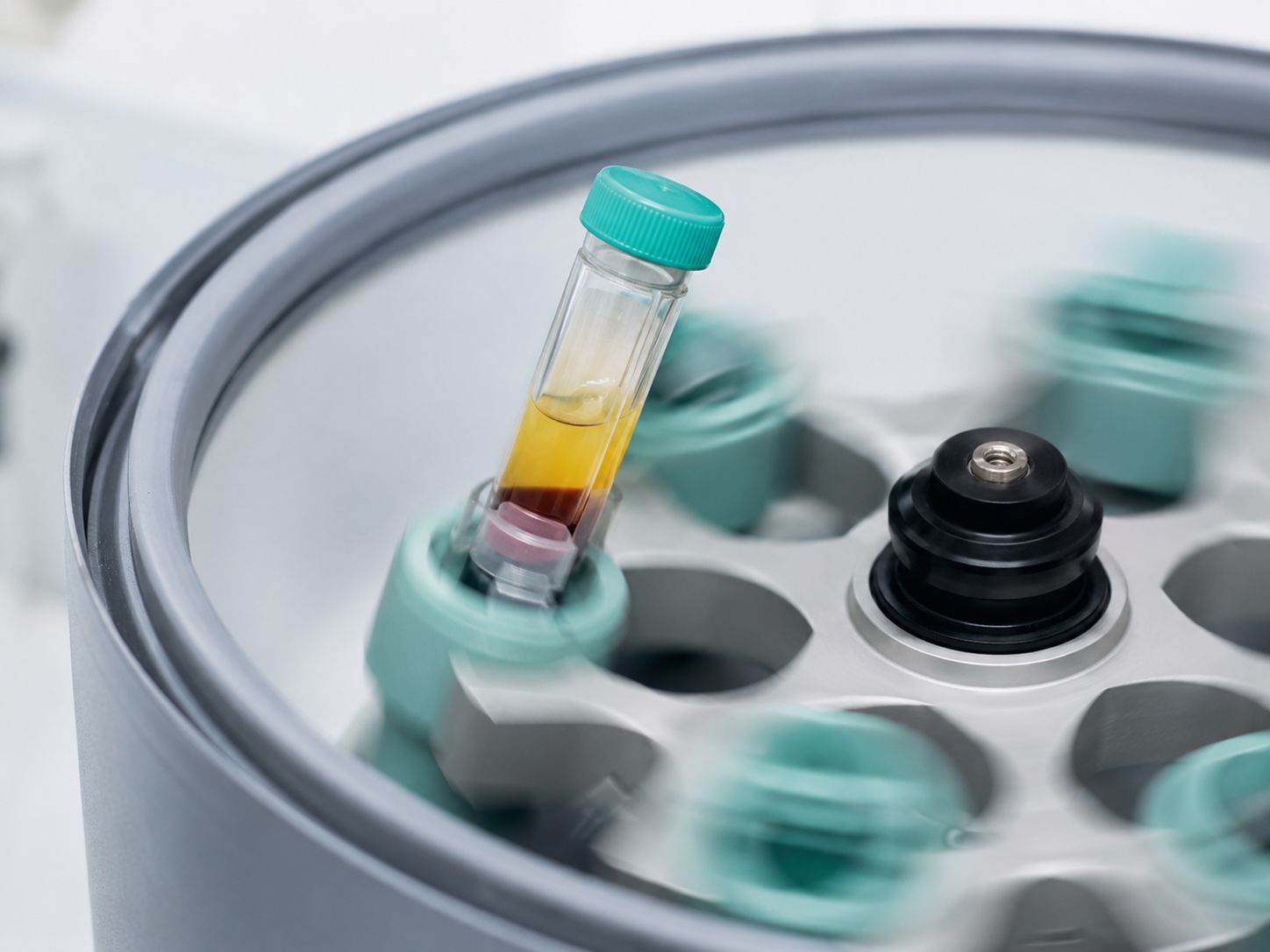

Everything happens during the appointment itself, in the consulting room. The clinician draws a small volume of the patient’s blood straight into the single-use RegenPRP device, and a single centrifugation separates the platelet-rich plasma from the red cells through the fixed separating gel — no decanting, no pipetting, no manual mixing. The resulting autologous PRP is then injected at the target site in the same session. Confining the process to a closed, disposable circuit is deliberate: in an area where sterility matters a great deal, it removes the open-handling steps most likely to introduce contamination or inconsistency, and it lets the technique remain part of an ordinary gynecological or urological consultation rather than a hospital procedure. It calls for no dedicated laboratory, no cell-processing equipment and no return visit. Site-specific injection technique and session spacing are set out on the product page.

As with any platelet-based treatment, a study only means as much as the preparation it was built on; if the product shifts between sessions, the findings are hard to line up. A closed system that standardises the platelet concentrate takes that uncertainty out, giving every treatment the same starting composition irrespective of the operator — RegenPRP is leucocyte-reduced and reproducible by design. RegenLab’s technologies are underpinned by an extensive body of independent, peer-reviewed literature, including references in gynecological and urological applications that clinicians can review when assessing the approach for their own patients. We do not restate trial conclusions on this page; the science hub instead brings the relevant references together in one place, so they can be examined in full and against the claims each market allows. Before adopting RegenPRP in this setting, practitioners should work through both that literature and the regulatory file that governs their region.
Because the preparation is autologous and hormone-free, it is often considered where local hormonal treatment is contraindicated or declined. Authorized use is market-specific.
The preparation is made entirely from a small sample of the patient's own blood, with nothing added — no hormones, no donor material and no synthetic active — which keeps it within standard autologous considerations and makes it an option where hormonal treatment is unsuitable.
It is intended to sit within the clinician's overall management of the condition rather than replace it; how it is positioned depends on the case and on authorized use in each market.
Session number and spacing are protocol- and market-dependent; the recommended scheme is set out on the product page and in the regulatory documentation for your region.
Clinical documentation, onboarding and distributor contact for your region — all reachable through the contact form.