
RegenPRP-HA (Cellular Matrix) — standardised autologous PRP combined with non-cross-linked hyaluronic acid in one closed-circuit step. CE-marked (Class III). The technology behind orthopedics and aesthetics.
Request clinical documentation or distributor information for your region.
RegenPRP-HA — marketed as Cellular Matrix — is RegenLab’s combination product: the standardised RegenPRP prepared together with non-cross-linked hyaluronic acid, in a single closed-circuit tube. It is the technology behind the orthopedics and aesthetics applications.
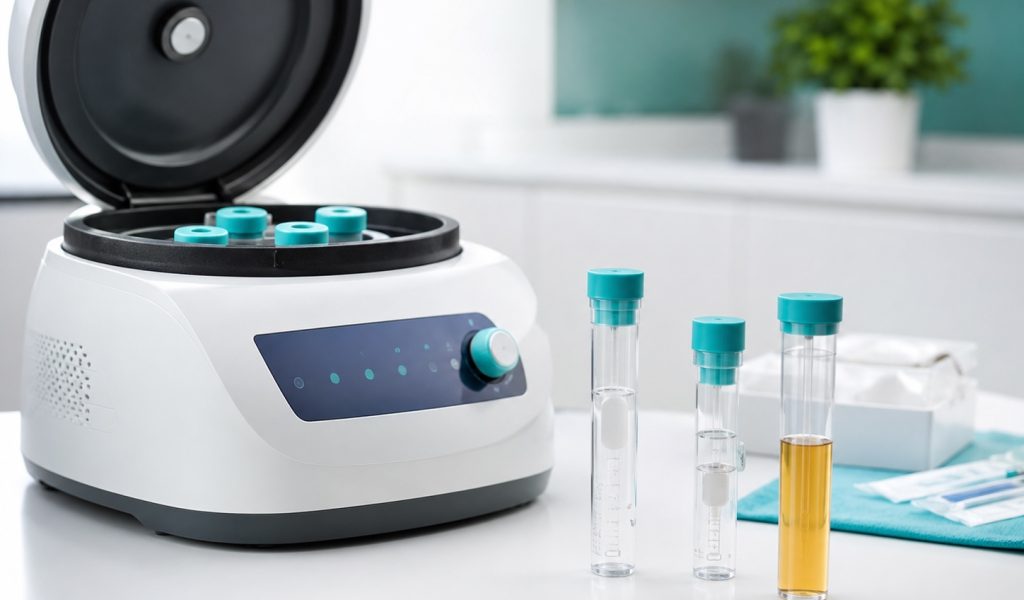
RegenPRP-HA is prepared with the Cellular Matrix kit, which brings two components together in a single closed-circuit tube. The first is the patient’s own platelet-rich plasma, produced exactly as base RegenPRP — pharmaceutical-grade glass tube under vacuum, sodium-citrate anticoagulant and the inert separator gel. The second is a fixed dose of non-cross-linked hyaluronic acid, produced by bacterial fermentation and therefore free of animal proteins. The kit ships in two variants that differ only in the PRP-to-HA ratio and final volume — a 50/50 preparation and a 60/40 preparation — so the practitioner can match the format to the indication. Nothing is weighed out or combined by hand: the HA is already in the tube, and the PRP joins it inside the sealed circuit. The result is a preparation of standardised, reproducible composition every time.
The whole preparation happens in one closed step, at the point of care. The patient’s blood is drawn directly into the Cellular Matrix tube, which already contains the hyaluronic acid; a single centrifugation — on the order of five minutes at around 1500 g — sends the red cells below the inert gel and leaves the platelet-rich plasma combined with the HA above it. There is no second spin, no open transfer between tubes and no manual mixing of the two components. The clinician then extracts the finished PRP-HA through the closed system straight into the injection syringe. Because the HA dose, the tube geometry and the spin parameters are all fixed, the ratio of platelets to hyaluronic acid is the same from one preparation to the next — the point of an “all-in-one” device, rather than combining a separate PRP and a separate HA by hand.
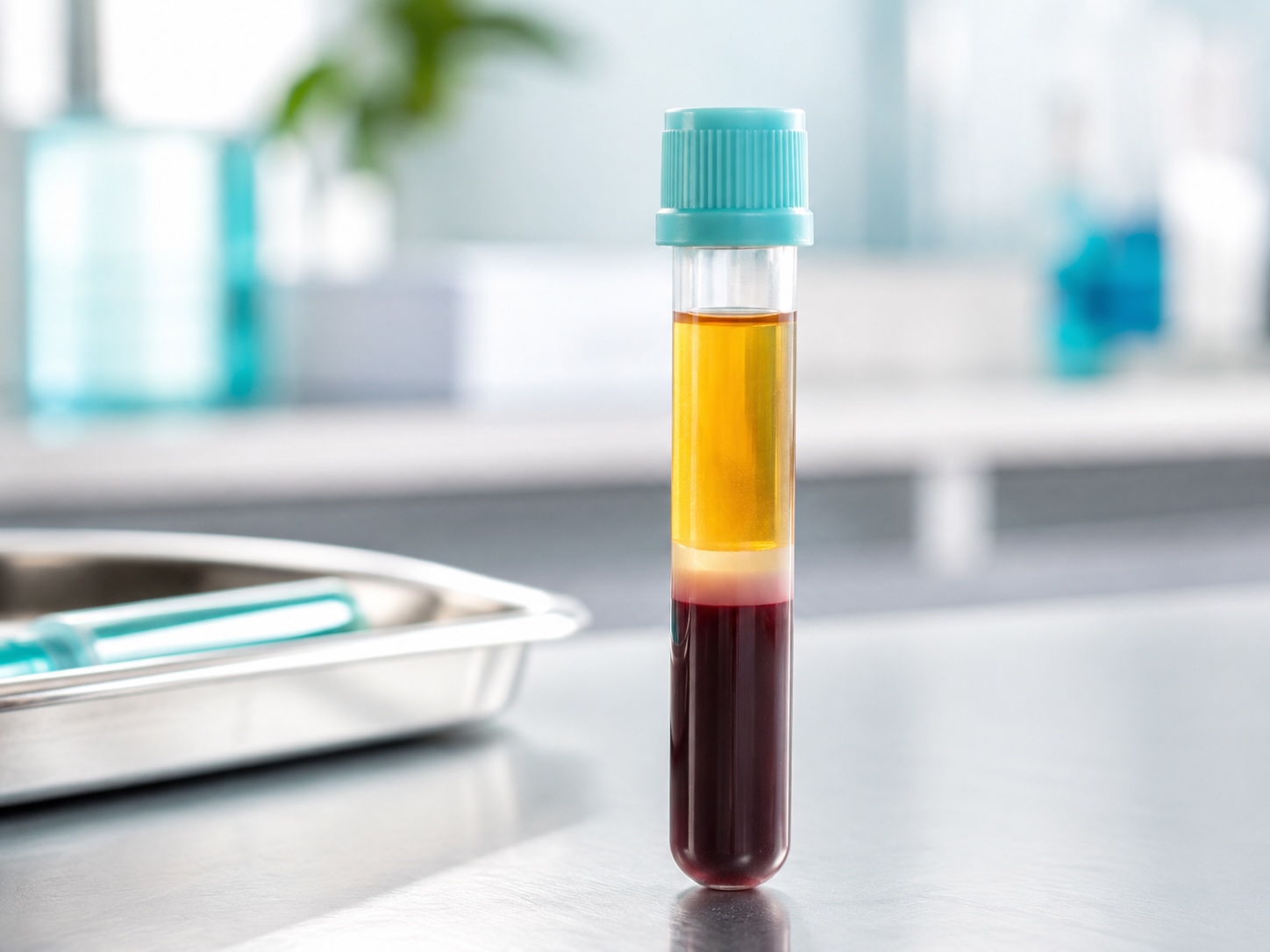

What distinguishes RegenPRP-HA is that the two components form a network rather than simply sitting side by side. The hyaluronic acid provides a bioactive scaffold within which the platelets release their growth factors progressively, rather than all at once — the intent being a more sustained local effect than PRP alone. HA also contributes its own well-established properties: viscoelasticity and hydration, relevant both in the joint (viscosupplementation) and in the skin. Importantly, the RegenPRP does not degrade the mechanical, elastic or viscous properties of the HA, so each component keeps doing what it does best. Underneath sits the same standardised, leucocyte-reduced PRP as the base product — reproducible platelet quality, minimal red cells, full plasma recovery. Combining a standardised PRP with a fixed HA dose is what keeps the whole preparation consistent.

RegenPRP-HA is the combination product behind two of RegenLab’s indication areas. In orthopedics it is injected intra-articularly for the symptomatic management of knee osteoarthritis, where the HA contributes viscosupplementation while the PRP supports the joint environment — the classic Cellular Matrix application, with the largest body of evidence. In aesthetics and dermatology it is used dermally as Cellular Matrix Skin, where the same PRP-HA network supports skin quality and biostimulation of the face, neck and décolleté. Each has its own clinical section, with the specific rationale, protocol and evidence. Availability is market-specific: PRP-HA is CE-marked in Europe but is not currently sold in the United States, so the US market relies on base PRP instead. For the indication-level detail, see each clinical page.
hey differ in the PRP-to-HA ratio and final volume — a 50/50 format and a 60/40 format — so the preparation can be matched to the indication.
Neither — it is non-cross-linked HA produced by bacterial fermentation, so it is free of animal proteins.
No. The HA acts as a scaffold for the progressive release of platelet growth factors, and the PRP does not degrade the mechanical, elastic or viscous properties of the HA.
No — PRP-HA / Cellular Matrix is not currently sold in the US (it remains under investigation there). It is CE-marked in Europe; the US market uses base PRP.
Yes — a Class III CE medical device, for intra-articular injection in knee osteoarthritis